|
|
|
Dr. Martha Bush Ashton Sikora was associated with Krishnattam during
the years 1970 to 1990. Through this beautifully produced monograph nicely
illustrated with many rare photographs,
she shares the
information collected by her on Krishnattam.
Dr. Sikora studied Yakshagana [1] a theatre form of South Kanara
District of Karnataka under the guidance of Hiriadka Gopala Rao. The search
for similarities between Yakshagana and other South Indian dance and theatre
forms, led them to see a performance of Krishnattam, the first play,
Avataram (Birth of Krishna) on the night of 6th May 1970 at a temple at
Arattupuzha, Trishshur District, Kerala. Thus Dr. Sikora's delightful
association with Krishnattam began as an unexpected adventure on
that night.
Dr. Sikora knew that Krishnattam performances were mostly held inside
Guruvayur Temple, where only Hindus are allowed. It was purely by chance
that she saw a performance of Krishnattam, held outside Guruvayur Temple
during that night.
Like curious students, she, her teacher Gopala Rao and friend Lakshmi
Kutty sat in the first row, near the manager of the troupe A.C.G. Raja,
who talked in general about Krishnattam and told them the synopsis of
the night's play. On Raja's invitation, Dr. Sikora visited Guruvayur
and saw Krishnattam being performed inside Guruvayur Temple by standing
in the balcony of a hotel. Later she saw a training session at the
Krishnattam Kalari (Training School) which was then housed in the
Zamorin's Palace at Guruvayur.
During her subsequent trips to India, Dr. Sikora visited Guruvayur many times,
met A.C.G. Raja, discussed Krishnattam and went to the training school.
Years later, Dr. Sikora and Mr. Sanjeev Prakash (New Delhi) visited
Guruvayur in 1980 and met the Administrator of Guruvayur Devasvam for
making a documentary film on Krishnattam. This time, DR. Sikora was
allowed to enter the Temple compound and watch Krishnattam.
She watched the Krishnattam plays Rasakrida, Kamsavadham and
Svayamvaram, performed inside the Guruvayur Temple. For collecting
historical data on Krishnattam as a part of documentation, Dr. Sikora
went to
Calicut, met the 89 year old Zamorin, Kizhakke Kovilakam Maron Raja and
visited the Tali temple. (The Krishnattam troupe belonged exclusively to the
Zamorin King of Calicut before it was handed over to Guruvayur Krishna
Temple Administration in 1958. Over a period of time Dr. Sikora
interviewed many senior members of the Zamorin family.) Subsequently Dr. Sikora saw the Krishnattam plays
Banayuddham and Vividavadham. The documentary project did not come
through since application for grant was not approved (1981).
(Later in 1982 Adoor Gopalakrishnan made a documentary film, Krishnattam,
for Films Division, Government of India.)
By 1982, Dr. Sikora decided to work on a monograph on Krishnattam and began to
collect as much information as possible. With Raja as the translator, Dr.
Sikora
interviewed the Krishnattam artists. During these interviews, she realized
the importance of Kuthanur in Palakkad District from where many of the
artists came. Dr. Sikora visited Kuthanur and came to know that Kuthanur
was the hometown of many experts of Carnatic Music, Kanyar Kali and
Tolpava Kuthu (Leather shadow puppetry).
In 1983, Martha was able to see the play Kaliyamardanam and in 1985, she
saw the final play, Svargarohanam. During the fall of 1985, Dr. Sikora
toured with Krishnattam troupe as a lecturer and stage manager as a part of
Festival of India, USA.
The book, co-authored with Robert P. Sikora, has ten chapters. After Introduction (chapter 1), Dr. Sikora
presents the historical data on Krishnattam in four chapters,
Time of Zamorin's (1652 to 1955), Time of Transition (1955 to 1961),
Time at Guruvayur under A.C.G. Raja (1961 to 1983) and the recent time
(1983-1990). Chapter 6 is on training. Chapter 7 deals with preparations
and pre-performance rituals. Chapter 8 is on the performance. Artists'
opinions and suggestions are summarized in the ninth chapter. The future
challenges faced by Krishnattam are discussed in the last chapter.
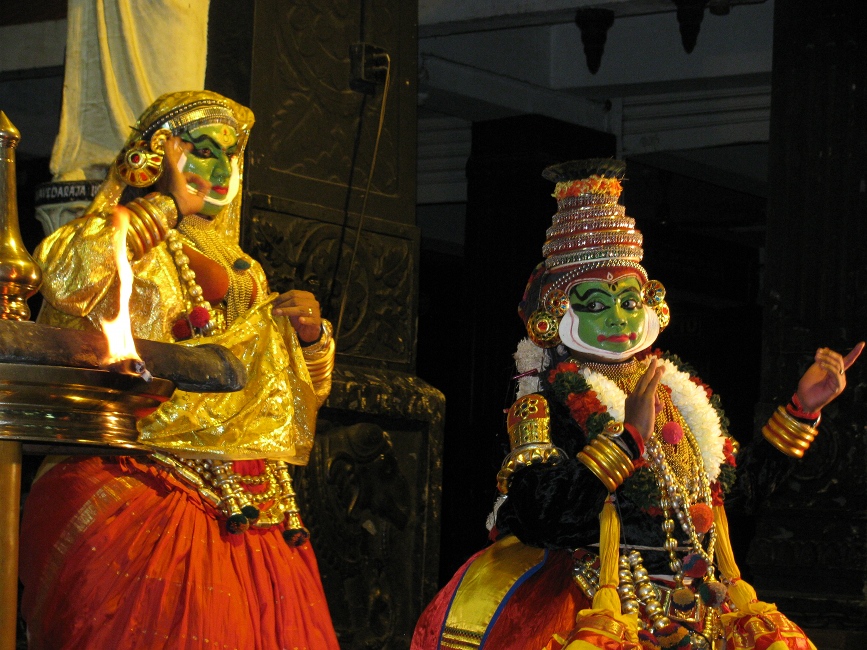
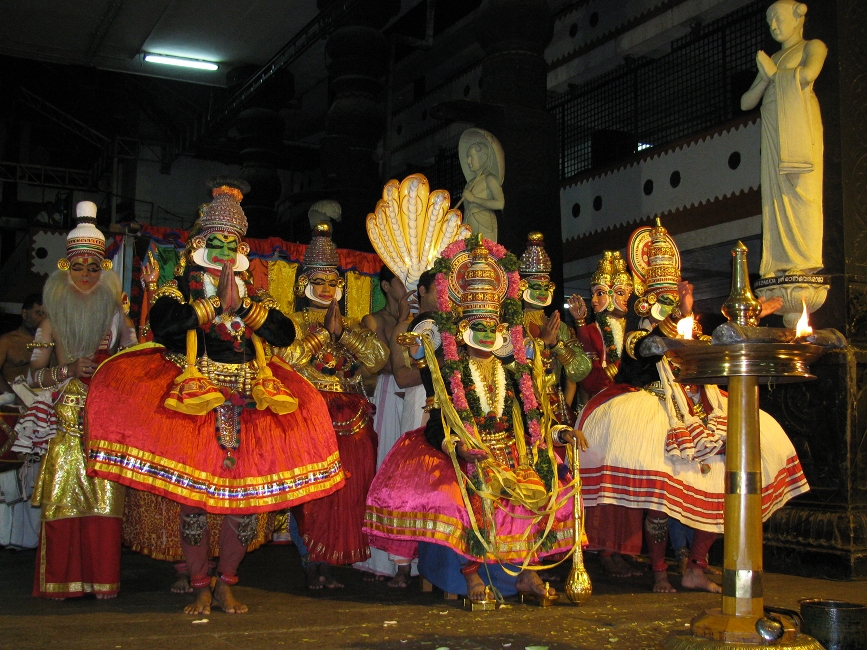
The book has a frontispiece and eighteen plates showing various characters
and scenes from Krishnattam. A map showing the range of Zamorin's
influence (1663 - 1694) is also presented in the book. There are 10
Appendices including the synopsis of the eight plays and invaluable
information such as places of performance of Krishnattam during the time of
Zamorin's patronage.
A glossary of various Sanskrit and Malayalam words is given in the book along
with their meanings and explanations. A Bibliography and index are included
for the researcher.
To collect as much data as possible, Dr. Sikora visited the important places,
met people people from all walks of life connected with Krishnattam,
spent time with the artists and conducted interviews with A.C.G. Raja
acting as the interpreter most of the time. Thus the author was able to
gather many precious personal views on Krishnattam, which gives us rare
glimpses into a bygone era. She did the most to
promote Krishnattam outside India as well.
There are a few errors such as, on page 102: "Today one person acts four
different characters in Svargarohanam". This should read as Svayamvaram.
The few errors can be rectified in future editions.
To date (2012), this is the only book in English or in any other language
for that matter which provides precise
information on Krishnattam, with the sole exception being the late Prof. P.C.
Vasudevan Elayath's scholarly introduction to his Malayalam prose
translation of
Krishnagiti [2]. Dr. Sikora has managed to collect and present
information on all aspects of the performance in spite of her lack of
knowledge of Sanskrit as well as Malayalam.
Some of the outstanding features of the book are descriptions of dance
steps, training of dancers, musicians and drummers, pre-performance rituals,
details of the materials used for dresses, ornaments and elaborate and
exquisite facial makeup. Many important changes in relation to makeup, music
and other aspects of performance took place prior to visit of the troupe
to the U.S.A. Dr. Sikora, because of her closeness to the troupe, had a
ring-side view of these changes, so to speak. The historians and
connoisseurs of Krishnattam are thus gifted with this very valuable
material.
The author has not flooded the book with dry discussions of performance
theories or related manuals. They are not altogether neglected either. For
example, Kalayavana's movements in the play Svayamvaram are connected by the
author to relevant passages in Natyashastra.
The book, written in a elegant style conveying the author's enthusiastic
feelings on Krishnattam, is a pleasure to read and is valuable to the general
readers, aficianados of Krishnattam and historians of
traditional art forms, folklore, sanskrit ritual theatre
and culture.
[1] Martha Bush Ashton, Yakshagana:
A Dance Drama of India, South Asia Books (1977).
Martha Bush Ashton, "Yakshagana Badagatittu Bayalata: A South Indian Dance
Drama," Ph.D. Dissertation, Michigan State University, 1972.
http://www.yakshaganakendra.com
[2] Krishnanattam (Krishnagiti) with Malayalam translation by
P.C. Vasudevan Elayath,
Published by Guruvayur Devaswom, Kerala, India. Second Edition 2009.